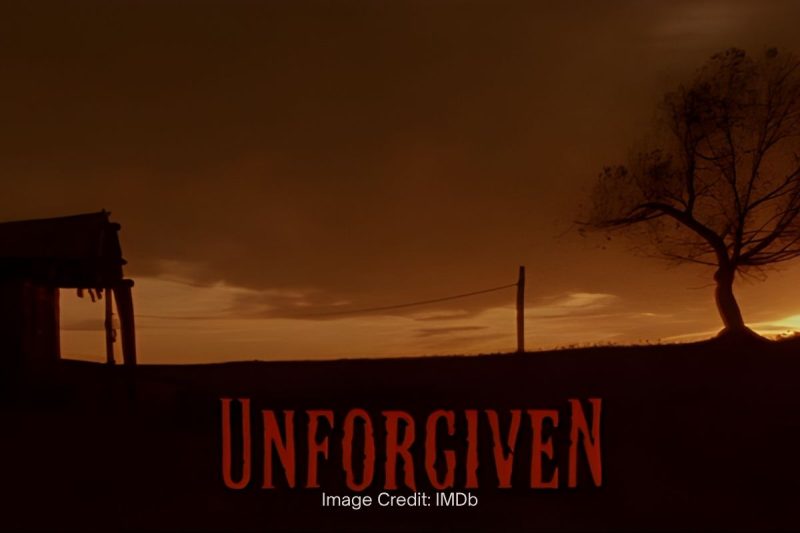
In the American West of the 1880s, a silver dollar wasn’t just currency. It was a unit of survival, a measure of a person’s worth, and sometimes, the difference between life and death.
Clint Eastwood’s Unforgiven (1992) understands this better than almost any Western ever made.
Set in 1881, the same period when Morgan silver dollars circulated as the backbone of frontier commerce, the film turns a simple $1,000 bounty into a meditation on violence, guilt, and the cost of reducing human beings to dollar amounts.
Unforgiven won four Academy Awards, including Best Picture and Best Director, and is widely regarded as one of the greatest Westerns of all time.
However, what makes it endure isn’t the gunfights or the grit. It’s the way money moves through every scene, corrupting everyone it touches and forcing each character to confront what they’re willing to do, and who they’re willing to become, for a bag of silver.
The Plot: Blood Money in Big Whiskey
The Incident That Starts It All
The story begins with a brutal act. In the fictional town of Big Whiskey, Wyoming, a cowboy named Quick Mike slashes the face of a young prostitute named Delilah Fitzgerald after she laughs at him. The attack is vicious and personal, leaving her permanently disfigured.
Sheriff “Little Bill” Daggett, played by Gene Hackman, is called in to handle the situation, but instead of delivering real justice, he frames it as a property dispute.
Delilah is, legally speaking, an asset of Skinny DuBois, the saloon owner who holds her contract. Little Bill orders the cowboys to compensate Skinny with ponies for his “damaged property.”
The prostitutes are outraged. Not because justice failed, but because they weren’t even part of the equation. In Little Bill’s courtroom, a woman’s disfigured face is worth less than a horse.
The Bounty
Determined to take matters into their own hands, the prostitutes pool their savings and offer a $1,000 reward for the deaths of Quick Mike and his partner Davey Bunting. One thousand dollars in 1881 was a staggering sum, roughly equivalent to over $30,000 today.
For women earning pennies per encounter, this represented their collective life savings, every coin carefully set aside, now put toward retribution.
This bounty becomes the engine of the film. It draws in characters from across the frontier, each with their own desperate reasons for wanting the money.
William Munny: A Killer on a Pig Farm
The protagonist, William Munny, played by Eastwood himself, is introduced not on horseback but in a pig pen, failing to separate his sick hogs.
He’s a former outlaw, once notorious for killing women and children in drunken rampages, now reformed by his late wife Claudia. He’s broke. His farm is dying. His children need him to provide.
When a young, nearly blind would-be gunfighter called the Schofield Kid shows up at the farm to recruit him, Munny’s first instinct is to refuse. He’s done with killing. But the money is too much to ignore when your children are hungry and your hogs are dying.
He convinces his old partner Ned Logan, played by Morgan Freeman, to join him. The three ride for Big Whiskey, and the past Munny thought he’d buried begins to claw its way back to the surface.
Little Bill’s Reign of Control
Meanwhile, Big Whiskey’s sheriff runs the town with an iron fist disguised as law. Gene Hackman’s Little Bill is one of cinema’s most compelling antagonists, not because he’s evil in the traditional sense, but because he genuinely believes his brutality is in service of order.
When the flamboyant gunfighter “English Bob,” played by Richard Harris, rides into town with his biographer W.W. Beauchamp seeking the bounty, Little Bill publicly beats him to a pulp.
It’s not justice. It’s a demonstration. He’s telling every would-be bounty hunter that Big Whiskey has its own law, and that law is his fists.
Little Bill even deconstructs the mythology of the Old West for Beauchamp, explaining that famous gunfights weren’t won by the fastest draw but by whoever stayed coolest under fire.
He’s a man who understands violence intimately and uses it strategically. That makes him far more dangerous than any storybook villain.
The Killings and Their Aftermath
The bounty hunting itself is nothing like the myths. The first target, Davey, is killed in an ambush while surrounded by his fellow cowboys. He dies slowly, screaming for water. It’s grotesque and painful, stripping away any illusion of heroism.
Ned, sickened by what he’s done, abandons the mission and heads home. But he’s captured by Little Bill’s men and tortured to death in the jail. His body is displayed in an open coffin outside Skinny’s saloon, a warning to others.
When Munny learns of Ned’s death, something breaks open inside him. He starts drinking again. The man his wife tried to save disappears, and what takes his place is something older and far more dangerous.
The Final Reckoning
The climax of Unforgiven is one of the most iconic sequences in Western cinema. Munny walks into Skinny’s saloon alone, brandishing a shotgun. He kills Skinny for displaying Ned’s body. His shotgun misfires when he turns it on Little Bill.
What follows is a gunfight that shouldn’t be survivable. Munny kills five armed deputies in a dim, chaotic barroom. He finishes Little Bill with a revolver shot and then rides out into the rain, shouting threats to anyone who might follow.
It’s not triumph. It’s devastation. Munny didn’t reclaim his honor. He reclaimed his worst self, and the money that started it all barely registers anymore.
Characters and Performances
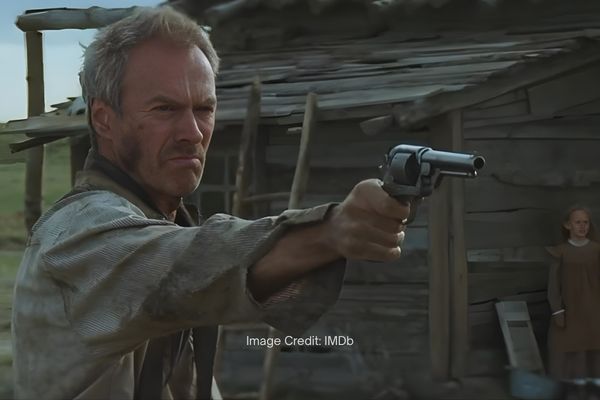
William Munny: The Reluctant Monster
Eastwood’s performance is a masterclass in restraint. For most of the film, Munny is quiet, weak, and hesitant. He falls off his horse. He can barely aim. He refuses whiskey, not because he doesn’t want it, but because he knows what he becomes when he drinks.
This is what makes the final act so devastating. The man who shuffles through the first two hours of the film transforms into an unstoppable force. Eastwood plays both versions with total conviction, and the contrast between them is the heart of the film’s power.
Munny is named after money for a reason. He’s what happens when economic desperation overrides moral reform. His journey is not redemption; it’s a relapse.
Little Bill Daggett: Order Without Justice
Gene Hackman won a Best Supporting Actor Oscar for this role, and it’s easy to see why.
Little Bill is terrifying because he’s recognizable. He’s the authority figure who confuses control with righteousness, who enforces the law selectively, and who genuinely believes his cruelty keeps people safe.
His relationship with Beauchamp reveals his vanity. He loves debunking myths about other gunfighters while building his own legend.
He’s building a house throughout the film, a literal and figurative attempt to construct something lasting, but the house leaks and the walls don’t fit. His world is as poorly constructed as his carpentry.
Ned Logan: The Conscience That Can’t Survive
Morgan Freeman’s Ned is the most humane character in the film. He rides out with Munny for the bounty but can’t pull the trigger when the moment comes. His retreat from violence is honest and deeply felt, but in the world of Unforgiven, conscience is a vulnerability.
His capture and death at Little Bill’s hands is the film’s most devastating turn and the catalyst for Munny’s final transformation.
The Schofield Kid: Youth Confronting Reality
Jaimz Woolvett plays the Kid as a young man in love with the myth of the gunfighter. He’s nearly blind, lies about his experience, and talks big about killing. When he actually takes a life, firing through the wall of an outhouse at the second cowboy, he’s wrecked by it.
His confession to Munny afterward is one of the film’s most quoted moments: “It’s a hell of a thing, killing a man. Take away all he’s got and all he’s ever gonna have.” The Kid gives up the revolver and the reward, wanting nothing more to do with any of it.
Money, Silver, and the Currency of Violence
The Bounty as Moral Engine
Every character in Unforgiven is pulled into orbit by the $1,000 bounty. English Bob. The Schofield Kid. Ned Logan. Even Little Bill, who claims to be enforcing the law, is really defending his own economic and social authority.
The prostitutes’ decision to offer the bounty is itself an act of economic rebellion. They’ve been reduced to property by Skinny and ignored by Little Bill. Their only power is financial, and they wield it with ferocity.
But the money doesn’t buy justice. It buys death, guilt, and the destruction of everyone who touches it.
Silver Dollars on the Frontier
Set in 1881, Unforgiven takes place at the height of the Morgan silver dollar’s circulation. First minted in 1878 under the Bland-Allison Act, the Morgan dollar was the primary large-denomination coin in the American West throughout the 1880s and 1890s.
Saloon transactions, cattle deals, bounties, and poker pots were all settled with these heavy silver coins.
When the prostitutes in Big Whiskey pooled their earnings to create a $1,000 reward, they would have been counting out stacks of these distinctive silver pieces, each one bearing the profile of Lady Liberty on the obverse and a heraldic eagle on the reverse.
Today, Morgan dollars can be very valuable, with rare dates and mintmarks commanding thousands or even tens of thousands of dollars at auction.
The coins that once changed hands in frontier saloons are now prized by collectors for their historical significance and craftsmanship.
In the context of the film, the silver has a different kind of weight. Each coin represents a choice, a compromise, and, ultimately, a life.
Skinny’s Saloon and the Circle of Commerce
One of the film’s sharpest details is the price Skinny paid for his saloon: $1,000. The same amount as the bounty.
When Munny kills Skinny in the climax, the film closes a financial loop. The bounty that drew Munny to Big Whiskey equals the cost of the establishment where the violence finally peaks.
This isn’t a coincidence. Unforgiven is a film built on economic symmetry. Violence and commerce are interchangeable. Every transaction has a body count, and every death has a price tag.
Themes: Deconstructing the Western Myth
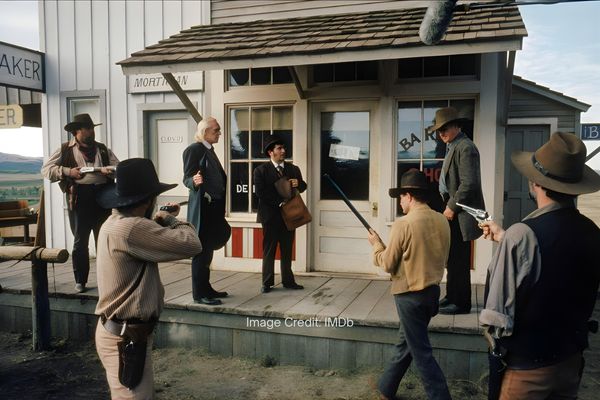
The Lie of the Heroic Gunfighter
Unforgiven systematically dismantles the mythology that Eastwood himself helped build over decades of Western filmmaking. There are no quick-draw duels at high noon. There’s no code of honor. Killing is messy, traumatic, and morally corrosive.
Beauchamp, the biographer, serves as the audience’s surrogate. He arrives in Big Whiskey believing in legends, in noble gunslingers and dramatic showdowns. By the end, he’s witnessed the truth: violence is ugly, random, and driven by desperation, not heroism.
Justice as a Marketplace
The film presents justice as something bought and sold, never freely given.
The legal system, represented by Little Bill, treats a woman’s disfigurement as property damage. The alternative system, the bounty, treats murder as a commodity. Neither approach delivers anything resembling moral resolution.
This economic framing of justice gives the film a modern edge. It’s not just about the Old West; it’s about any society where the rules favor those with power and money.
Violence and the Myth of Redemption
Unforgiven rejects the idea that violence can be redemptive. Munny’s final rampage doesn’t restore order or avenge his friend in any meaningful way. It simply proves that he never really changed and that the killer was always there beneath the surface.
The film’s closing text tells us that Munny eventually moved to San Francisco and “prospered in dry goods,” a darkly ironic coda suggesting that even the worst monsters can reinvent themselves when the money is right.
Direction and Craft
Eastwood’s Restraint Behind the Camera
As a director, Eastwood matches his performance. He is restrained, deliberate, and unhurried. The film’s pacing is slow by modern standards, but every scene earns its length. The long stretches of quiet build toward eruptions of violence that feel earned rather than gratuitous.
The Wyoming landscape is filmed with a cold, unsentimental eye. There’s beauty there, but it’s harsh and indifferent. The weather is a constant presence, with rain, wind, and cold reminding the characters (and the audience) that the frontier doesn’t care about their stories.
Cinematography and Sound
Jack N. Green’s cinematography uses natural light and muted tones to create a world stripped of Hollywood polish. The interiors are dark and cramped. The exteriors are vast and exposed.
The contrast mirrors the film’s themes: people trapped by circumstance in a world too big and indifferent to notice.
Lennie Niehaus’ score is spare and haunting, used only in key moments. Much of the film relies on ambient sound, such as creaking wood, rain on rooftops, and distant thunder, to build its atmosphere. The restraint makes the moments of violence hit harder.
Legacy and Lasting Impact
Unforgiven is often cited as Eastwood’s farewell to the Western genre, a reckoning with the mythology he helped create as the Man with No Name in Sergio Leone’s Dollars Trilogy.
It was dedicated to his mentors, Leone and Don Siegel, acknowledging the tradition it both honors and dismantles.
The film’s influence extends beyond Westerns. Its themes of violence, commerce, and the failure of justice resonate in modern crime dramas and revisionist narratives.
It proved that the genre still had stories worth telling, as long as those stories were willing to confront uncomfortable truths.
For those who appreciate films that challenge rather than comfort, Unforgiven remains essential viewing. It’s a film that asks what justice costs, who pays the price, and whether any amount of silver is worth what it takes to earn it.
Rating: 8.2/10