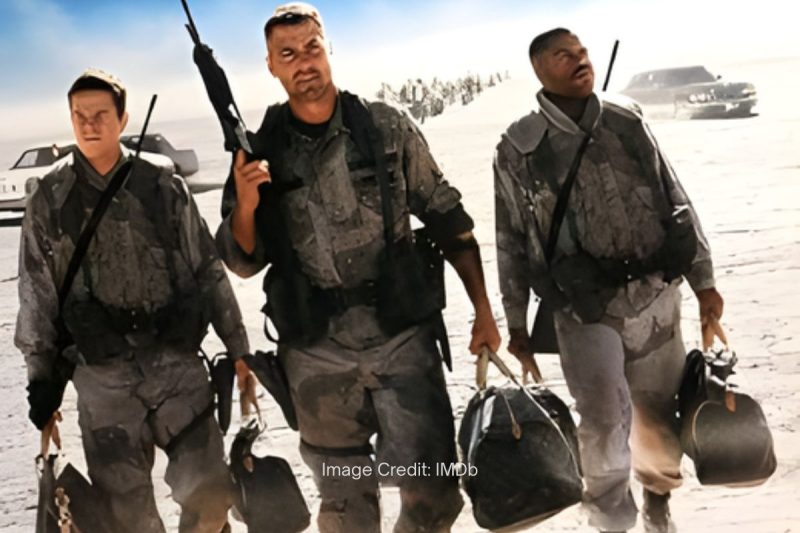
In 1999’s Three Kings, what begins as a straightforward gold heist movie quickly mutates into something far more unsettling and unforgettable.
Set in the immediate aftermath of the Gulf War, the film uses its genre-blending approach to ask hard questions about loyalty, justice, and the human cost of conflict.
Beneath the gunfire and desert chases lies a sharp critique of American intervention, told through the eyes of soldiers chasing stolen Kuwaiti gold. What they find instead is a crisis of conscience.
Most gold heist stories, from the infamous Brink’s-Mat robbery to the Great Gold Robbery of 1855, follow a familiar arc: insider access, elaborate planning, and a high-stakes getaway.
Three Kings borrows those elements but places them in a war zone, where the real treasure may not be gold at all.
Director David O. Russell crafts a film that’s as morally complex as it is visually daring, challenging the conventions of both the heist movie and the war film.
Plot Summary
The Setup: Post-War Chaos and Opportunity
Three Kings opens in the strange calm that followed the 1991 Gulf War ceasefire. American soldiers are stationed in Iraq, but the lines between war and peace are blurred.
Amid the confusion, a group of U.S. servicemen stumbles upon a crude map hidden in the body cavity of a captured Iraqi soldier. The map points to a bunker where stolen Kuwaiti gold bars, plundered by Saddam Hussein’s forces, are believed to be stored.
The war may be over, but the chaos on the ground suggests otherwise. Civilians are caught between the remnants of Saddam’s regime and the uncertain promises of U.S. withdrawal.
In this volatile setting, the soldiers see an opportunity not just for profit but for escape from the moral murk of military service.
The Heist Plan
Led by Special Forces Major Archie Gates (George Clooney), the group includes the idealistic Sergeant Troy Barlow (Mark Wahlberg), the spiritually grounded Chief Elgin (Ice Cube), and the eccentric Conrad Vig (Spike Jonze).
What starts as a rogue mission to retrieve stolen gold quickly morphs into an elaborate and risky gold heist.
Their plan is classic heist movie fare: exploit insider knowledge, use military gear for access, and extract high-value assets under the radar.
But unlike typical gold heists such as the Brink’s-Mat robbery, where insider access and deception were the main tools, Three Kings layers on the unpredictability of a war zone.
The soldiers expect resistance but not the kind that challenges their very sense of purpose.
The Moral Shift
Once the team reaches the gold, they discover something far more troubling: Iraqi civilians, including women and children, are being tortured and executed by loyalist forces.
The soldiers come face-to-face with the human cost of their mission. The gold is real, but so is the suffering.
This moment shifts the film’s tone from stylish heist movie to something deeper. The operation becomes less about stealing and more about saving lives, integrity, and perhaps their own sense of justice.
The soldiers must decide whether to stick to the plan or intervene at great personal risk.
Themes and Tone
Greed vs. Duty
The film’s central tension rests between personal enrichment and moral obligation. At first, the soldiers are motivated by greed.
Like many real-world gold heists, from the Great Gold Robbery of 1855 to the Perth Mint Swindle, the plan depends on knowledge of logistics and a willingness to bend the rules. But as the story unfolds, the gold becomes secondary to the lives at stake.
The characters’ transformation mirrors the ethical questions posed by historical heists. Is insider advantage a license to steal, or does access come with responsibility?
Three Kings doesn’t answer these questions simply; it forces its characters to wrestle with them in real time.
Satire and War Critique
Director David O. Russell uses dark humor and stylized violence to critique the American military’s role in foreign conflicts.
The film’s satire is biting, from soldiers celebrating victory in a war they barely understand to bureaucrats more concerned with paperwork than people.
The use of absurdity is deliberate. Scenes of grotesque violence are paired with surreal visuals, creating a jarring blend that reflects the confusion and moral ambiguity of post-war Iraq.
The film doesn’t mock war; it mocks the arrogance and detachment that often accompany it.
The Cost of Conscience
As the soldiers shift from thieves to reluctant saviors, the film poses a powerful question: What are you willing to sacrifice to do the right thing?
For Archie and his team, the answer isn’t abstract. Their decision to help civilians puts them at odds with their own military, risking court-martial or worse.
The film doesn’t offer easy redemption. Each character pays a price, whether in physical suffering, psychological trauma, or disillusionment. In this way, Three Kings becomes less about heroism and more about accountability.
Characters and Performances

Archie Gates (George Clooney)
George Clooney brings depth to Major Archie Gates, a character who begins as a jaded opportunist but reveals a moral core beneath the cynicism.
Clooney’s performance balances charm with gravitas, making his transformation believable. He commands the screen without overshadowing the ensemble, anchoring the story with authority and nuance.
Troy Barlow (Mark Wahlberg)
Wahlberg’s Troy Barlow is the emotional center of the film. A young father and reservist, Troy is drawn into the mission reluctantly. His arc includes one of the movie’s most harrowing moments: an interrogation scene that strips away the glamour of war and exposes its brutality.
Wahlberg conveys vulnerability and resolve with equal skill, making Troy’s journey one of the most compelling.
Chief Elgin and Conrad Vig (Ice Cube and Spike Jonze)
Ice Cube plays Chief Elgin with quiet strength. As the team’s moral compass, Elgin brings a sense of spiritual clarity to the chaos. His performance is understated but powerful, grounding the film’s more surreal moments.
Spike Jonze, in contrast, plays Conrad Vig with manic energy. Initially comic relief, Vig’s tragic undertones emerge as the story deepens. Jonze’s performance is unpredictable, adding texture to a character who could have been a simple caricature.
Action and Cinematic Style
Innovative Cinematography
Three Kings is visually distinct, thanks to its use of bleach-bypass processing, which creates a high-contrast, desaturated look. This technique gives the desert scenes a gritty, almost surreal quality.
Russell also uses slow motion and X-ray-style visuals to depict bullet trajectories and internal injuries, emphasizing the physical toll of violence in a way that feels both stylized and grounded.
Tense, Gritty Action Sequences
The film’s action scenes are not just adrenaline-fueled; they’re emotionally charged.
The gold heist itself is tense, but the real suspense comes during the prisoner rescue and the team’s escape under fire. These sequences blend tactical realism with moral stakes, making every bullet count.
Realism Meets Stylization
The movie walks a fine line between war film authenticity and heist movie flair. It captures the dirt, confusion, and unpredictability of combat but filters it through a lens that’s both artistic and purposeful.
The result is a film that feels at once grounded and heightened, much like the best entries in both genres.
A Gold Heist Movie in a War Movie’s Clothing
Echoes of Real Gold Heists
At its core, Three Kings is a gold heist movie. The soldiers use insider knowledge, exploit chaos, and plan a high-stakes theft, which are hallmarks of real-world heists like the Brink’s-Mat robbery.
That 1983 crime involved insider access, threats of violence, and a treasure of nearly 7,000 gold bars. The parallels are striking, even if the settings are worlds apart.
Insider Access and Deception
Just as historical heists often hinge on insider betrayal or security lapses, such as the use of duplicate keys in the Great Gold Robbery of 1855, the soldiers in Three Kings rely on military intelligence and their own credentials to bypass checkpoints and access restricted areas.
The film cleverly depicts these tactics, showing how institutional knowledge can be both a weapon and a liability.
The Value of Gold vs. Human Life
In the end, the film poses a timeless question: What’s worth more, gold or people? In heist lore, the answer is often ambiguous. But Three Kings makes its stance clear through the characters’ choices.
The gold may be real, but its value pales next to the lives at risk. That moral clarity sets the film apart from traditional heist narratives, where the treasure is usually the goal, not the obstacle.
Legacy and Impact
Critical Reception and Awards
Three Kings received widespread acclaim for its daring blend of genres and its unflinching look at post-war consequences. Critics praised its originality, visual style, and political commentary.
While it wasn’t a major awards contender, its lasting impact lies in how it expanded the boundaries of both war and heist films.
Influence on War and Heist Films
The film paved the way for more morally complex war movies, influencing titles like The Hurt Locker and Jarhead.
Its genre-blending approach also impacted heist films, showing that a gold heist could be more than a caper; it could be a lens for deeper themes.
A Standout Entry in the Heist Movie Canon
Despite its war setting, Three Kings stands out as one of the most provocative gold heist movies ever made. It captures the thrill of the score, the complications of the plan, and the emotional fallout, all while asking questions that most heist films avoid.
Why This Film Is Still Relevant
Three Kings remains a rare achievement: a gold heist movie that dares to question the worth of its own premise. Its fusion of war film grit and heist movie tension creates a story that is as entertaining as it is thought provoking.
The performances are rich with nuance, the cinematography is bold, and the themes remain relevant in today’s world of endless conflict and ethical gray zones.
As someone who’s logged thousands of hours watching and reviewing action movies, I think Three Kings earns its place not just as a standout gold heist film but also as a rare war movie that challenges both its characters and its audience.
Whether you’re drawn to the thrill of the heist or the weight of moral reckoning, this film delivers both with equal force.
If you haven’t seen it, or haven’t seen it in years, watch it soon. You may find that the real treasure isn’t buried in the sand but in the questions the film refuses to let you ignore.